


OMIM ID:
Cole-Carpenter Syndrome 1
Alternate Names
Defective Genes
Clinical Characteristics
Ocular Features
The bony orbits are shallow and the eyes appear prominent as part of the facial and skull bone deformities. The proptosis may be progressive and eventually interfere with blinking and normal surface wetting of the cornea.
Systemic Features
This condition may superficially resemble osteogenesis imperfecta with osseous deformities and frequent fractures. However, the occurrence of craniosynostosis and hydrocephalus helps to distinguish it. Cranial sutures may be slow to fuse and macrocephaly has been described. Communicating hydrocephalus can be a feature and may require shunting. Some patients have osteopenia of the long bones that fracture easily.
The facial features are said to be distinctive with midface hypoplasia, low-set ears, micrognathia, and, of course, prominent globes. Growth may be subnormal and a variety of limb bone and digital anomalies have been described. Intelligence is normal, however.
Genetics
Inheritance
This condition is the result of heterozygous mutations in the P4HB gene (17q25.3) (PDI family).
See Cole-Carpenter Syndrome 2 (616294) for a somewhat similar disorder that is recessively inherited.
Pedigree
Autosomal dominant
Autosomal dominant disorders require only one mutation for the disease to be expressed. Since an affected parent has two chromosomes, only one of which has the mutant gene, parents can expect that half (50%) of their children will receive that one and inherit the disease. It is common for individuals that inherit the mutation, however, to not have evidence of the disease (nonpenetrance).
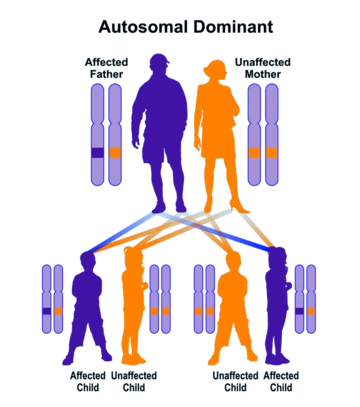
Autosomal dominant inheritance leads to a vertical pattern of transmission